
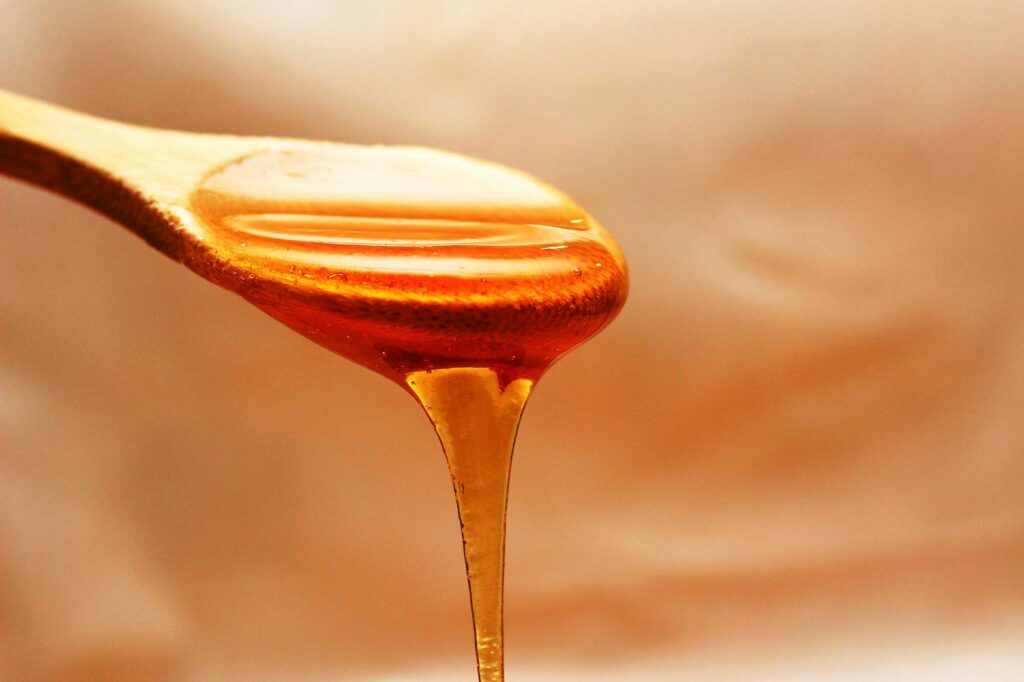
Manuka honey has moved from health food shop curiosity to clinically recognised wound treatment. But is it a miracle substance, a misunderstood traditional remedy, or simply clever marketing wrapped in scientific language. The answer, as ever in evidence based medicine, lies somewhere in between.
Where It Comes From
Manuka honey is produced by bees that pollinate the Leptospermum scoparium shrub, native to New Zealand and parts of Australia.
What sets it apart from conventional honey is its concentration of methylglyoxal, often abbreviated to MGO. This compound is believed to contribute significantly to its distinctive biological activity. However, MGO is only part of the story. Acidity, osmotic effects from high sugar content, hydrogen peroxide production and various plant derived compounds all play a role.
The question is not whether Manuka honey does anything at all. It clearly does. The real question is what it does reliably, and in which clinical settings.
Antibacterial and Antimicrobial Activity
Laboratory Evidence
Manuka honey demonstrates broad antibacterial activity in laboratory studies. It has been shown to inhibit a wide range of organisms, including antibiotic resistant strains such as methicillin resistant Staphylococcus aureus and vancomycin resistant enterococci.
Importantly, research suggests it can disrupt bacterial biofilms. These biofilms act as protective communities that shield bacteria from antibiotics and immune responses. Disrupting them is clinically valuable in chronic wound care.
The antibacterial effect is multifactorial. It is not simply the presence of MGO, but a combination of low pH, osmotic pressure, hydrogen peroxide and phytochemical components. This complexity may help explain why resistance development appears uncommon, although long term surveillance data remain limited.
Wound Healing and Medical Use
This is where the strongest evidence lies.
Manuka honey is among the most extensively studied honeys for wound management. A Cochrane review examining honey as a topical treatment for wounds concluded that honey dressings can accelerate healing of partial thickness burns and some surgical wounds when compared with certain conventional dressings.
Randomised controlled trials have demonstrated improved healing times in selected wounds, including diabetic foot ulcers. The evidence is not universal across all wound types, but it is sufficiently robust that sterilised, medical grade Manuka honey dressings are now widely used in clinical practice within the United Kingdom and internationally.
These products are regulated medical devices, processed to ensure sterility and consistent activity. This is a critical distinction. Clinical outcomes relate to medical grade preparations, not jars purchased from supermarket shelves.
In wound care, therefore, Manuka honey is not myth. It is a regulator approved adjunct supported by systematic review level evidence.
Oral and Throat Health
Claims surrounding oral and throat health are more nuanced.
Laboratory studies suggest Manuka honey may reduce levels of bacteria associated with plaque formation and gingivitis. Some small human studies indicate potential benefits for oral hygiene when used in lozenges or rinses.
Many individuals report symptomatic relief from sore throats. This is biologically plausible given its antibacterial and anti inflammatory properties, as well as its soothing viscosity. However, high quality, large scale clinical trials remain limited. Current evidence supports possible benefit, but not definitive therapeutic claims.
Antioxidant and Anti-Inflammatory Properties
Manuka honey contains higher concentrations of phenolic compounds than many standard honeys. These compounds confer antioxidant capacity, enabling neutralisation of free radicals in laboratory assays.
Anti-inflammatory effects have been observed in cell and animal models. Such findings are scientifically interesting, particularly given the role of oxidative stress and inflammation in chronic disease.
However, translation from laboratory bench to meaningful clinical outcomes in humans requires careful scrutiny. At present, robust human data demonstrating systemic anti inflammatory benefit following ingestion are limited.
What the Evidence Does Not Yet Support
Ingestion for Systemic Disease
While topical use is supported by credible evidence, claims that eating Manuka honey significantly improves gut health, boosts immunity in a measurable way, or treats systemic disease are not backed by high quality clinical trials.
Higher MGO ratings do not necessarily translate into enhanced effects once consumed. The compound is metabolised, and its activity within the gastrointestinal tract may differ substantially from its behaviour in a petri dish. Some human studies report no measurable alteration in gut microbiota following consumption.
Chronic Disease Claims
Assertions that Manuka honey cures or meaningfully treats diabetes, cardiovascular disease or cancer are not supported by rigorous clinical research. Such claims exceed the available evidence and would not meet regulatory standards for medicinal approval.
Safety and Practical Guidance
For most adults, Manuka honey is safe when used appropriately.
Topical application using licensed, medical grade products is well established in wound care practice.
When consumed, it should be regarded as a sugar rich food. Individuals with diabetes or impaired glucose tolerance should seek medical advice before regular use due to its glycaemic impact.
As with all honey, it must not be given to infants under one year of age because of the risk of botulism.
Understanding MGO in Manuka Honey
Methylglyoxal, commonly abbreviated to MGO, is a naturally occurring reactive compound found in unusually high concentrations in Manuka honey. It forms from dihydroxyacetone, a substance present in the nectar of the Leptospermum scoparium plant, during the honey maturation process.
MGO is considered one of the principal contributors to Manuka honey’s non peroxide antibacterial activity. Unlike many conventional honeys, whose antimicrobial effect depends largely on hydrogen peroxide, Manuka honey retains antibacterial potency even when hydrogen peroxide is neutralised. This stability is one reason it has attracted clinical interest in wound care.
Commercial Manuka products are often graded according to their MGO concentration, expressed in milligrams per kilogram. Higher numbers indicate greater measured MGO content. However, it is important to note that antibacterial activity reflects the interaction of multiple factors, not MGO alone. Furthermore, higher MGO ratings do not necessarily translate into superior systemic health benefits when the honey is consumed, as the compound is metabolised in the human body.
In short, MGO is central to Manuka honey’s distinctive laboratory and topical antimicrobial properties, but it should be understood as one component within a broader and biologically complex profile.
MGO Levels Explained Concisely
Manuka honey is commonly labelled with an MGO number, which indicates the concentration of methylglyoxal in milligrams per kilogram.
As a general guide:
- MGO 100 to 250 – Lower activity range. Suitable for general dietary use but limited evidence for clinical effect.
- MGO 300 to 400 – Moderate antibacterial activity in laboratory studies.
- MGO 500 and above – High antibacterial potency in vitro, typically used in medical grade preparations for wound care.
Higher MGO numbers reflect stronger measured antibacterial activity in laboratory testing. However, clinical effectiveness depends on formulation, sterility and appropriate medical use, not the number alone.
Conclusion. What the Science Actually Supports
Manuka honey occupies an unusual space between traditional remedy and modern evidence based intervention.
The science supports:
- Strong antibacterial activity in laboratory and clinical wound settings
- Accelerated healing in certain burns and surgical wounds
- Regulator approved use in medical grade wound dressings
- Demonstrated antioxidant and anti inflammatory activity in experimental models
The science does not yet support:
- Broad claims of systemic disease treatment through ingestion
- Assertions that higher MGO ratings guarantee superior health outcomes
In short, Manuka honey is neither madness nor miracle. It is one of the most thoroughly researched medicinal honeys available, with credible, regulator accepted clinical application in wound care and local antimicrobial use.
Beyond that, the story remains promising but unfinished.
References
- Jull AB, Cullum N, Dumville JC, et al.
Honey as a topical treatment for wounds.
Cochrane Database of Systematic Reviews. 2015; Issue 3: CD005083. - Molan PC.
The evidence supporting the use of honey as a wound dressing.
International Journal of Lower Extremity Wounds. 2006;5(1):40 to 54. - Carter DA, Blair SE, Cokcetin NN, et al.
Therapeutic Manuka honey: No longer so alternative.
Frontiers in Microbiology. 2016;7:569. - Johnston M, McBride M, Dahiya D, et al.
Antibacterial activity of Manuka honey and its components against oral pathogens.
Journal of Antimicrobial Chemotherapy. 2011;66(11):2532 to 2538. - Majtan J.
Honey: An immunomodulator in wound healing.
Wound Repair and Regeneration. 2014;22(2):187 to 192. - World Health Organization.
Guidelines on wound management and infection prevention.
World Health Organization.